Flamenco in Madrid for first-timers — the honest guide
You are coming to Madrid for the first time, or perhaps you have been before but never seen flamenco. You search online, find dozens of options, and quickly get confused. Dinner shows. Gala shows. Tourist shows. Authentic shows. Prices ranging from €20 to €120. How do you choose?
This guide gives you the honest answer — written by the team behind two of Madrid's most respected tablaos, with over 30 years of experience in authentic flamenco.
The one thing a first-timer needs to know: don't pay for the dinner. Pay for the show. The quality of the flamenco and the quality of the paella have nothing to do with each other — but the price of one will often come at the expense of the other.
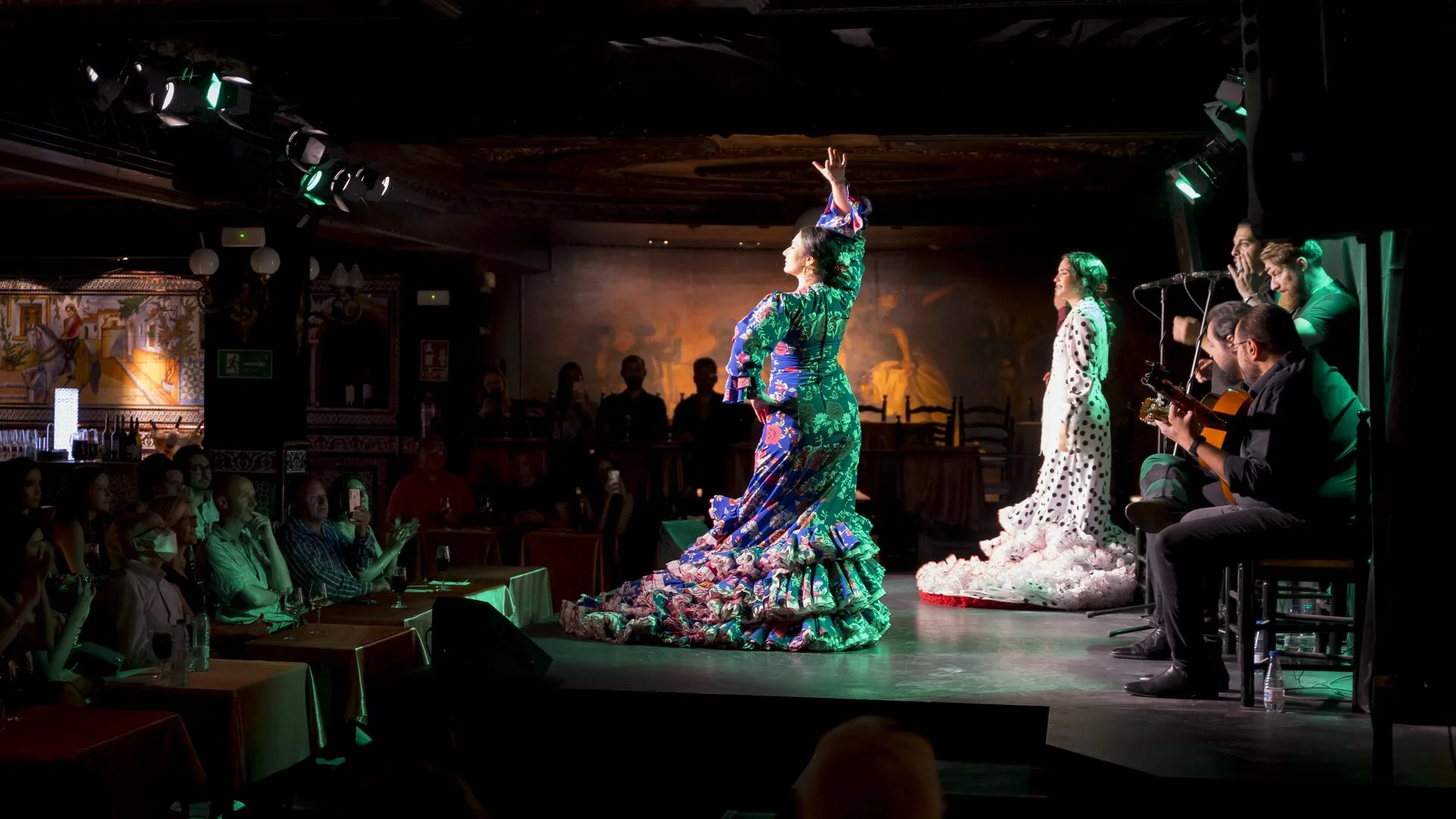
The dinner show trap
Madrid has many venues that market themselves as "flamenco dinner shows." The concept is appealing — you eat a Spanish meal, watch flamenco, and call it a night. For a first-timer, it sounds like a complete experience.
The problem is simple: when a venue is trying to run a restaurant and a flamenco show at the same time, something has to give. The economics of food service — multiple seatings, fast turnover, large capacity — are fundamentally incompatible with the conditions that produce great flamenco: intimacy, concentration, an audience that is fully present.
In the best tablaos, the show is everything. Food and drink are available — a welcome drink, tapas, wine — but they are incidental. The room is configured around the stage, not around the tables. The artists are professionals who have dedicated their lives to this art, not performers filling time between courses.
A warning sign: if a venue leads with the menu before it mentions the artists, that tells you everything you need to know about what they consider the main attraction.
What makes a great first flamenco experience
After thirty years of welcoming first-time visitors to our tablaos, we know what produces a genuinely memorable experience — and what disappoints.
Intimacy above everything
Flamenco was born in small, charged spaces — the cafés cantantes of 19th-century Seville and Madrid, where artists and audiences were close enough to touch. That proximity is not incidental — it is essential. The vibration of the footwork through the floor, the breath of the singer, the exchange of energy between performer and audience — none of this works at a distance.
Look for venues with under 200 seats. The smaller the better. A tablao with 100 seats where every seat has a direct sightline to the stage will give you a fundamentally different experience from a 400-seat theatre production, however technically impressive.
Professional resident artists
The best tablaos have resident companies — artists who perform together regularly, who know each other's musical language, who have built the kind of collective understanding that produces spontaneity on stage. This is different from assembling a cast of freelancers for each performance.
When you see a show where the guitarist and dancer have performed together for years, you see something that cannot be manufactured: a musical conversation that goes beyond technique into something genuinely alive.
The right show time
Most quality tablaos in Madrid offer four shows daily — typically at 18:00, 19:30, 21:00 and 22:30. For a first-timer, the 19:30 or 21:00 shows are the sweet spot. The 18:00 is often attended by those with early dinner reservations elsewhere — the audience is moving quickly. The 22:30 show attracts a later crowd, often more engaged, but it is a long night if you are not used to Spanish hours.
The 21:00 show tends to have the best combination of a fully warmed-up company and an audience that has settled in for the evening. If you can only see one show, that is the one.
Location matters less than you think
Many visitors assume that flamenco in Madrid means somewhere on the tourist trail — near the Prado, on Gran Vía, close to the Palacio Real. In reality, the best tablaos in Madrid are concentrated in the Barrio de las Letras — the neighbourhood around Calle Echegaray and Plaza de Santa Ana, a five-minute walk from Puerta del Sol.
This is Madrid's historic cultural quarter, where flamenco has been performed continuously for over a century. It is not a tourist district — it is a living neighbourhood where the art form has deep roots. Coming here for flamenco is not a detour from Madrid. It is the real Madrid.
Calle Echegaray, Plaza de Santa Ana and the streets around them form the heart of Madrid's flamenco scene. Both Cardamomo and Tablao Flamenco 1911 are here — two minutes' walk from each other, five minutes from Sol. Metro: Sevilla (L2) or Sol (L1/L2/L3).
How to read a tablao listing
When you are comparing venues online, here is what to look for — and what to ignore.
Look for
- Named artists — serious tablaos name their resident company. If you cannot find out who is performing, that is a red flag.
- Show duration of 60+ minutes — a proper flamenco show needs time to develop. Anything under 45 minutes is a highlight reel, not a performance.
- Small capacity — under 200 seats is good. Under 150 is excellent.
- External recognition — press coverage, cultural awards, institutional recognition. These are hard to fake.
- Consistent reviews mentioning the artists — not just "great atmosphere" but specific comments about the quality of the dancing, the guitar, the singing.
Be cautious of
- Very low prices — authentic professional flamenco costs money. Shows under €20 are almost always compromises.
- Venues that lead with dinner — as discussed above.
- Shows described as "the best of flamenco" or "greatest hits" — authentic flamenco does not work like a pop concert. If a venue is promising you the highlights, they are probably not giving you the depth.
- Very high prices with no clear reason — some venues charge €80–100 per person on the basis of reputation alone. Price is not a reliable indicator of quality in either direction.
What to do during the show
First-time visitors sometimes feel self-conscious — they do not know the conventions, they are not sure how to react. Here is everything you need to know.
- Put your phone away — or at least keep it in your pocket. The artists will notice, and more importantly, you will miss the show. Flamenco happens in real time and cannot be captured adequately on a phone screen.
- Do not applaud between numbers unless invited — flamenco performances have their own rhythm of release and tension. Applauding at the wrong moment can break something delicate. Wait for the natural pauses.
- It is absolutely fine to say "Olé" — or any of the other exclamations you hear from the other artists on stage. If something moves you, it is appropriate to express it. Flamenco is not a concert where the audience sits in silence.
- Pay attention to the silences — some of the most powerful moments in flamenco happen in the spaces between sounds. The pause before a phrase, the stillness after a movement. These are not gaps — they are part of the performance.
- Watch the whole company, not just the dancer — the guitarist responding to the singer, the palmeros keeping time, the interaction between all the performers. The real show is often in those exchanges.
"You do not need to understand flamenco to be moved by it. But if you arrive open — without expectations, without your phone in your hand, without thinking about where you are eating afterwards — something will happen that you will not forget."
Frequently asked questions — first-time flamenco in Madrid
About the author
Miguel Blanco was born in Cadiz, the birthplace of flamenco, and fell in love with the art as a child. Today he lives in Madrid, where he has spent years following the city's tablao scene closely — which is how Flamenconearme.com came to be: the guide he wishes he'd had on day one. Read more